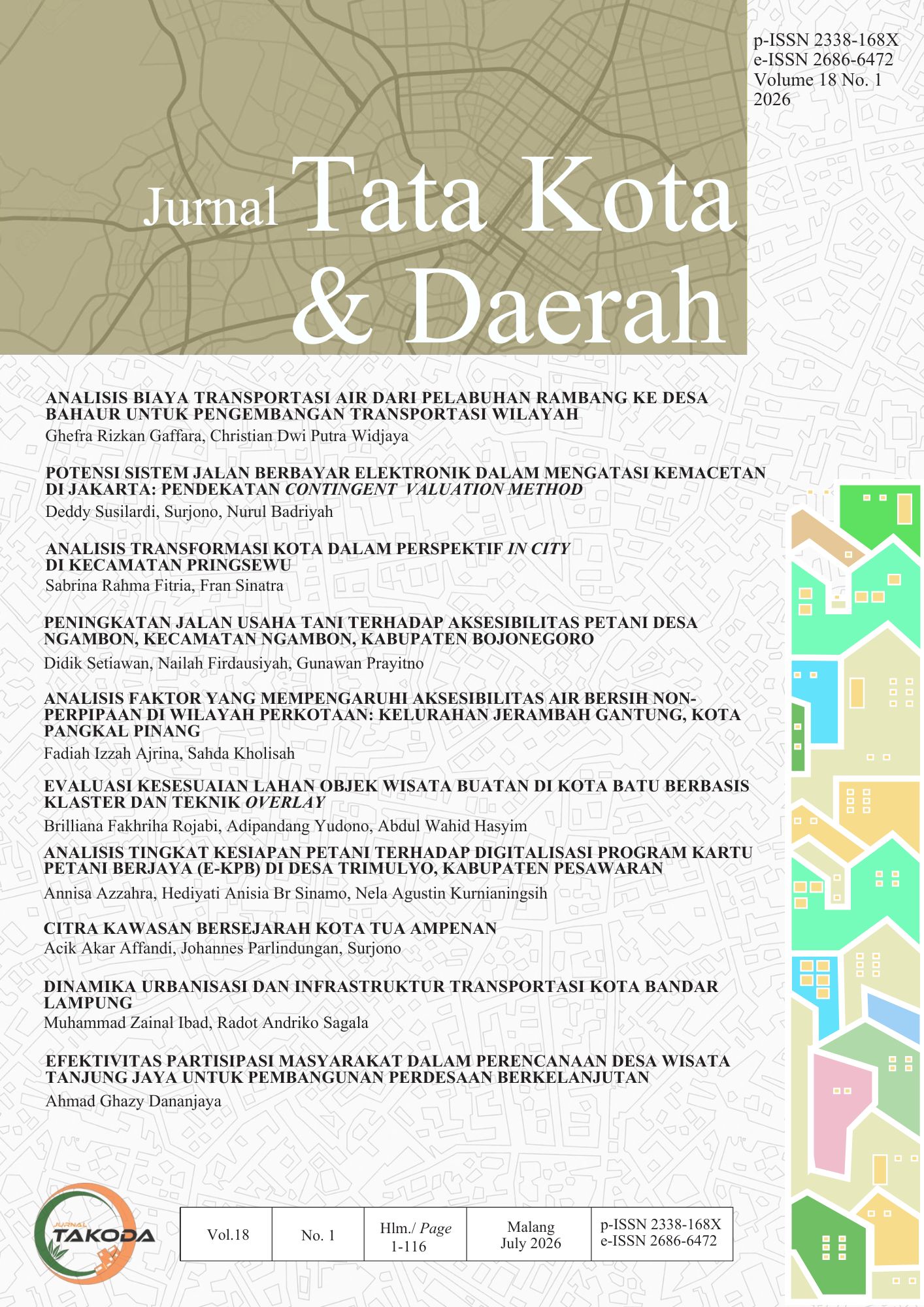
POTENSI SISTEM JALAN BERBAYAR ELEKTRONIK DALAM MENGATASI KEMACETAN DI JAKARTA: PENDEKATAN CONTINGENT VALUATION METHOD
DOI:
https://doi.org/10.21776/ub.takoda.2026.018.01.2Keywords:
Sistem Jalan Berbayar Elektronik, Contingent Valuation Method, Kesediaan Membayar, Transportasi BerkelanjutanAbstract
Masalah kemacetan yang dipicu oleh tingginya volume kendaraan bermotor di Jakarta, telah menjadi tantangan besar bagi pengelolaan transportasi. Salah satu pendekatan yang dapat dipertimbangkan untuk mengatasi tingkat kemacetan adalah penerapan Sistem Jalan Berbayar Elektronik (SJBE), sebuah sistem pembebanan biaya berbasis elektronik yang dikenakan pada kendaraan yang melintasi jalan tertentu pada waktu tertentu. Penelitian ini bertujuan untuk menilai potensi SJBE dalam mengurangi kepadatan lalu lintas dengan menggunakan pendekatan kesediaan membayar atau willingess to pay (WTP) masyarakat dan mencari faktor – faktor apa saja yang mempengaruhi nilai WTP. Penelitian ini menggunakan beberapa metode, yaitu dengan menggunakan pendekatan Contingent Valuation Method (CVM) untuk menentukan nilai WTP yang dikombinasikan regresi linear berganda untuk menentukan faktor apa saja yang mempengaruhi nilai WTP. Sedangkan potensi pengurangan kendaraan dihitung menggunakan teori probabilitas. Hasil menunjukkan bahwa dengan nilai WTP sebesar Rp21.423 untuk pengguna mobil dan Rp8.024 untuk pengguna motor. Hasil regresi linerar berganda faktor pendapatan, pengeluaran, frekuensi perjalanan per minggu dan kepemilikan kendaraan secara signifikan mempengaruhi nilai WTP. Sedangkan potensi pengurangan kendaraan mencapai 11,45% untuk mobil dan 6,93% untuk motor. Penelitian ini penting untuk memprediksi pengaruh penerapan SJBE dalam langkah awal mewujudkan transportasi berkelanjutan. Dengan transportasi berkelanjutan, tidak hanya akan meningkatkan kualitas lingkungan, tetapi juga mengurangi dampak perubahan iklim. Selain itu, sistem transportasi yang lebih bersih dan efisien dapat meningkatkan aksesibilitas, mengurangi kemacetan, dan meningkatkan kualitas hidup masyarakat secara keseluruhan.
References
PUSTAKA
Ahmed, S. K. (2024). How to Choose A Sampling Technique and Determine Sample Size for Research: A Simplified Guide for Researchers. Oral Oncology Reports, 12, 2. https://doi.org/https://doi.org/10.1016/j.oor.2024.100662
Alamneh, T., Mada, M., & Abebe, T. (2024). Assessing Willingness to Accept a Compensation for Evicted Land in Peri-Urban Areas: A Contingent Valuation Method. Heliyon, 10(22), e40209. https://doi.org/10.1016/j.heliyon.2024.e40209
Baranzini, A., Carattini, S., & Tesauro, L. (2021). Designing Effective and Acceptable Road Pricing Schemes: Evidence from the Geneva Congestion Charge. In Environmental and Resource Economics (Vol. 79, Issue 3). Springer Netherlands. https://doi.org/10.1007/s10640-021-00564-y
Bhouri, N., Campisi, T., Aron, M., & Mahdavi, S. M. H. (2025). Connectivity, Reliability and Approachability in Public Transport: Some Indicators for Improving Sustainability †. Sustainability (Switzerland), 17(2). https://doi.org/10.3390/su17020645
Chen, C. Y. T., Sun, E. W., Chang, M. F., & Lin, Y. B. (2023). Enhancing Travel Time Prediction with Deep Learning on Chronological and Retrospective Time Order Information of Big Traffic Data. Annals of Operations Research. https://doi.org/10.1007/s10479-023-05223-7
Clement, E. P., & Anieting, A. E. (2024). Improvement on Calibration Weightings in Stratified Random Sampling. International Journal of Statistical Sciences, 24(2), 125–136. https://doi.org/10.3329/ijss.v24i2.77999
Dinas Lingkungan Hidup Provinsi DKI Jakarta. (2023). Laporan Akhir Kegiatan Pemantauan Kualitas Udara Provinsi DKI Jakarta Tahun 2023.
Doumbia, M., Kouassi, A. A., Silué, S., Yoboué, V., Liousse, C., Diedhiou, A., Touré, N. E., Keita, S., Assamoi, E. M., Bamba, A., Zouzoua, M., Dajuma, A., & Kouadio, K. (2021). Road Traffic Emission Inventory in An Urban Zone of West Africa: Case of Yopougon City (Abidjan, Côte d’Ivoire). Energies, 14(4), 1–19. https://doi.org/10.3390/en14041111
Fatimah, U., Sudarti, S., & Yushardi, Y. (2024). Analisis Perbandingan Pencemaran Udara Selama dan Setelah Pandemi Covid-19 di DKI Jakarta. Saintifik, 10(1), 102–106. https://doi.org/10.31605/saintifik.v10i1.471
Frolich, D., Al Adib Sarker, M., & Jin, X. (2024). Evaluating The Potential for Micromobility in South Florida Through a Stated Preference Survey. International Journal of Transportation Science and Technology, xxxx, 1–20. https://doi.org/10.1016/j.ijtst.2024.07.010
Gössling, S., Neger, C., Steiger, R., & Bell, R. (2023). Weather, Climate Change, and Transport: a Review. Natural Hazards, 118(2), 1341–1360. https://doi.org/10.1007/s11069-023-06054-2
Hashem, R. B., Siddique, A. B., Rasel, S. M., & Hossain, M. S. (2024). Assessment of Knowledge, Attitudes, and Practices Regarding Air Pollution Among Traffic Polices in Dhaka City, Bangladesh: a Cross-Sectional Study. BMC Public Health, 24(1). https://doi.org/10.1186/s12889-024-21086-4
Hawkins, J., & Habib, K. N. (2020). Heterogeneity in Marginal Value of Urban Mobility: Evidence from A Large-Scale Household Travel Survey in The Greater Toronto and Hamilton Area. Transportation, 47(6), 3091–3108. https://doi.org/10.1007/s11116-019-10041-7
Helmmie, E., & Joewono, T. B. (2022). Elasticity of Travel Time and Travel Cost of Private Vehicles and Public Transportation in Bandung, Indonesia. Civil Engineering Dimension, 24(2), 101–108. https://doi.org/10.9744/ced.24.2.101-108
Janie, D. N. A. (2012). Statistik Deskriptif & Regresi Linear Berganda dengan SPSS. In A. Ika (Ed.), Semarang University Press (1st ed., Issue April 2012). Semarang University Press.
Lera-López, F., Sánchez, M., Faulin, J., & Cacciolatti, L. (2014). Rural Environment Stakeholders and Policy Making: Willingness to Pay to Reduce Road Transportation Pollution Impact in the Western Pyrenees. Transportation Research Part D: Transport and Environment, 32, 129–142. https://doi.org/10.1016/j.trd.2014.07.003
Liu, Y., & Dong, F. (2021). Exploring the Effect of Urban Traffic Development on PM2.5 Pollution in Emerging Economies: Fresh Evidence from China. Environmental Science and Pollution Research, 28(40), 57260–57274. https://doi.org/https://doi.org/10.1007/s11356-021-14366-8
Mikhaylov, A., Moiseev, N., Aleshin, K., & Burkhardt, T. (2020). Global Climate Change and Greenhouse Effect. Entrepreneurship and Sustainability Issues, 7(4), 2897–2913. https://doi.org/https://doi.org/10.9770/jesi.2020.7.4(21)
Muñoz Miguel, J. P., García Sipols, A. E., Simón de Blas, C., & Anguita Rodríguez, F. (2021). A Model to Evaluate the Effect of Urban Road Pricing on Traffic Speed and Congestion in Madrid City Center and Its Surrounding. Sustainability, 13(15), 8415. https://doi.org/https://doi.org/10.3390/su13158415
Nguyen, S.-T., Moeinaddini, M., Saadi, I., & Cools, M. (2024). Unveiling the Drivers of Modal Switch from Motorcycles to Public Transport in Southeast Asia. Transportation Research Part F: Traffic Psychology and Behaviour, 102, 373–391. https://doi.org/10.1016/j.trf.2024.03.009
Olesków-Szlapka, J., Pawlyszyn, I., & Przybylska, J. (2020). Sustainable Urban Mobility in Poznan and Oslo-Actual State and Development Perspectives. Sustainability (Switzerland), 12(16), 1–37. https://doi.org/10.3390/su12166510
Pertiwi, T. A., Noechdijati, D., & Dharmawan, B. (2022). Analisis Kesediaan Membayar (Willingness to Pay) Pengunjung dalam Upaya Pengembangan Agrowisata “Sweetberry” di Kabupaten Cianjur. Jurnal Ekonomi Pertanian Dan Agribisnis, 6(2), 500. https://doi.org/10.21776/ub.jepa.2022.006.02.15
Rocha, H., Lobo, A., Tavares, J. P., & Ferreira, S. (2023). Exploring Modal Choices for Sustainable Urban Mobility: Insights from the Porto Metropolitan Area in Portugal. Sustainability, 15(20), 14765. https://doi.org/10.3390/su152014765
Spadaro, I., Pirlone, F., & Candia, S. (2022). Sustainability Charter for Innovative Cities and Safe Mobility. Case study: Sestri Levante. Transportation Research Procedia, 60(2021), 212–219. https://doi.org/10.1016/j.trpro.2021.12.028
Susanty, A., Rizkita, S. S., Purwanggono, B., Suliantoro, H., & Aladib, B. A. (2024). Analysis of the Willingness to Pay for Energy-Efficient Inverter AC using the Contingent Valuation Method (CVM). Procedia Computer Science, 241, 280–287. https://doi.org/10.1016/j.procs.2024.08.038
Tamminga, K., & Knüvener, T. (2021). On Sustainable|Sustaining City Streets. Sustainability (Switzerland), 13(4), 1–3. https://doi.org/10.3390/su13041895
Zulkarnain, Y. P., Tini, W., & Faritzie, H. Al. (2022). Analisa Probabilitas Pemilihan Moda Transportasi Antara Sepeda Motor Dengan Angkutan Umum. Jurnal Desiminasi Teknologi, 10(2). https://doi.org/10.52333/destek.v10i2.939
Downloads
Published
How to Cite
Issue
Section
License
Copyright (c) 2026 Deddy Susilardi, Surjono, Nurul Badriyah

This work is licensed under a Creative Commons Attribution 4.0 International License.
Authors who publish with this journal agree to the following terms:
- Authors retain copyright and grant the journal right of first publication with the work simultaneously licensed under a Creative Commons Attribution License that allows others to share the work with an acknowledgement of the work's authorship and initial publication in this journal.
- Authors are able to enter into separate, additional contractual arrangements for the non-exclusive distribution of the journal's published version of the work (e.g., post it to an institutional repository or publish it in a book), with an acknowledgement of its initial publication in this journal.
- Authors are permitted and encouraged to post their work online (e.g., in institutional repositories or on their website) prior to and during the submission process, as it can lead to productive exchanges, as well as earlier and greater citation of published work (See The Effect of Open Access).